
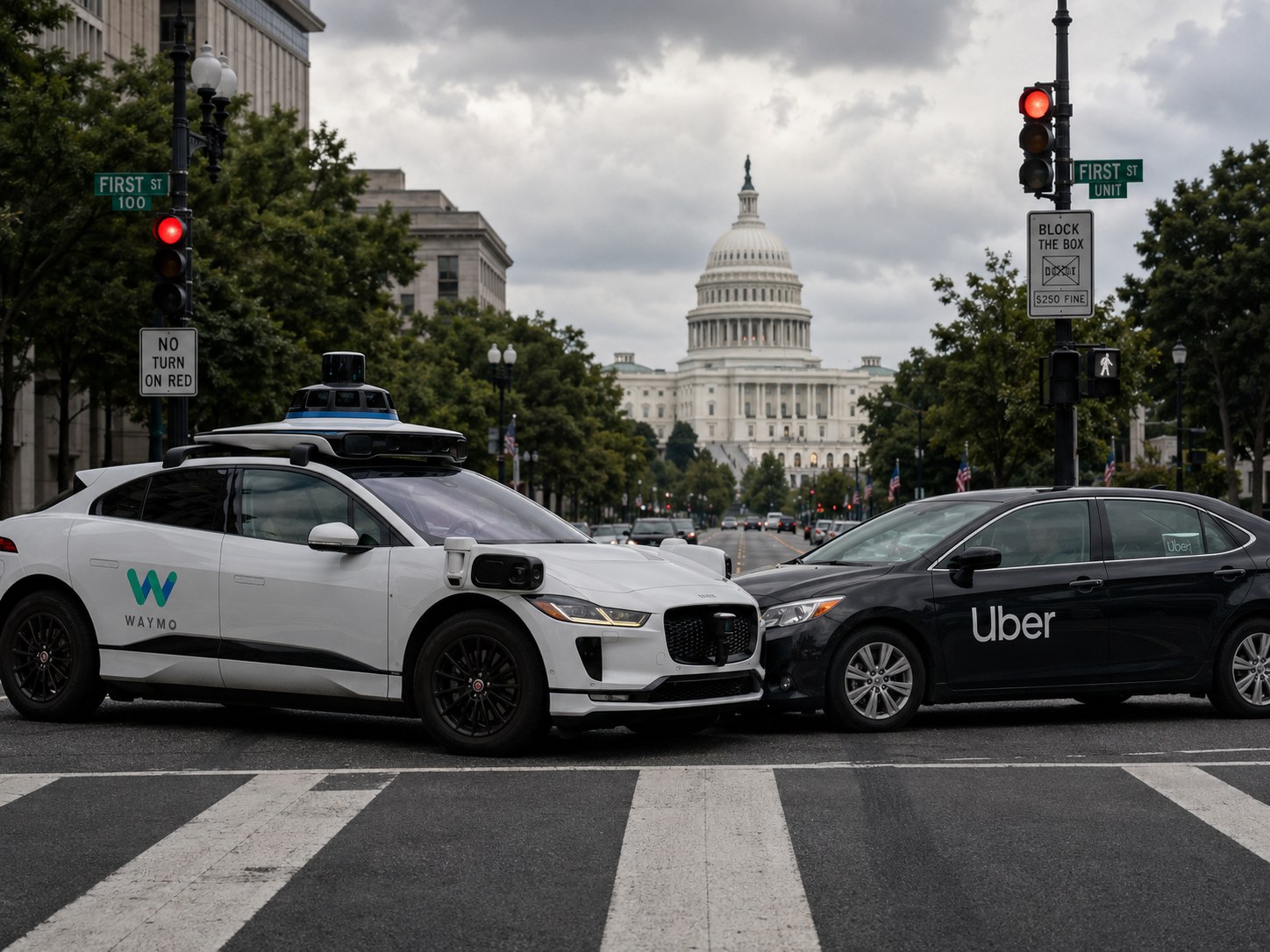
On Monday, July 13, the D.C. Council began debating a bill that would allow autonomous vehicles to operate commercially.
Current law in the city permits testing, but requires a human safety driver. Waymo - owned by Alphabet, Google's parent company - has been testing its vehicles there since 2024 and announced in March 2025 that its service would become available this year through Waymo One, its own app.
The company already employs dozens of people at a temporary facility and has begun developing two service and charging centers. At the latest legislative hearing, it said it would hire hundreds of workers if it receives authorization to operate.
Transportation unions, service workers, and app-based drivers mobilized as the bill proposed mandatory insurance, accident reporting, and a per-mile fee to fund public transit and support workers who lose their jobs.
In that context, Uber opposes the current wording of the proposed reform and presented its case in Washington on July 13 after requesting a hearing.
The dominant ride-hailing company - with 74 percent of the market, compared with just over 20 percent for Lyft - argues that Waymo's proposal could displace professional drivers and hand the company a de facto monopoly.
Uber's lawyers want robotaxis to be incorporated into hybrid networks: platforms where autonomous vehicles and human-driven cars offer rides at the same time. The company had already set out its arguments in a letter sent in June.
The dispute pits two companies against each other that are, at the same time, partners and competitors. In September 2024, they jointly announced that Waymo vehicles would arrive in Austin and Atlanta, but would be available only through the Uber app. Uber would manage and dispatch the fleet, as well as handle cleaning, repairs, and maintenance; Waymo would retain control over the driving system, testing, and roadside assistance.
The service launched in Austin in March 2025. By June of that year, one hundred Waymo vehicles were operating through Uber. In Atlanta, rides became available on June 24, 2025, across an initial 65-square-mile area. Passengers requesting certain Uber ride types may be matched with an autonomous vehicle without using a separate app.
Washington presents a different scenario. There, Waymo intends to reach the public directly through Waymo One. Uber, in response, wants the future rules to guarantee a role for platforms that combine autonomous and human-driven rides. Waymo says it opposes restrictions that would force autonomous vehicles to operate within a particular kind of network and asks lawmakers to allow different models to coexist.
Regulation as a Defensive Instrument
According to documents examined by Wired, an Uber representative promoted a provision in New Jersey that would have required, for three years, 85 percent of all rides offered by any platform to be completed by human drivers - a proposal strikingly similar to one now being advanced in Washington. A company devoted exclusively to robotaxis would obviously struggle to meet that condition through its own app.
Uber also argues that a gradual transition would protect jobs, preserve service in places where autonomous vehicles cannot yet operate, and prevent a single company from controlling the market. It points as well to congestion, assistance for older adults and people with disabilities, and the effect automation may have on drivers' income.
All of those concerns deserve consideration. Robotaxis clearly raise labor, urban, legal, and technical challenges.
But does it make sense to debate Uber on its legal arguments, technical concerns, and warnings about jobs without examining the company making them? How much confidence should we place in a battery of claims from a company whose position was diametrically opposed only a few years ago?
A Little Recent History
Between 2013 and 2020, Uber fought resistance on several fronts across Europe.
The company wanted to offer the same service it provides in the United States: drivers would not need professional licenses, they would work through a mobile app, and their cars would not have to meet the requirements imposed on taxis.
European local governments - Berlin's among them - demanded that Uber comply with the laws governing transportation companies. Uber went to court. Beyond the technical details, its central arguments were:
- Uber represented technological innovation against the old taxi system.
- It was not a transportation company, but a digital platform with a new business model.
- Its proposal created new jobs.
By 2022, after posting multibillion-dollar losses for more than a decade, Uber was valued at nearly $50 billion.
That same year, some of the world's most respected news organizations published the Uber Files, which revealed that the company had used unlawful tactics - including secret lobbying of high-profile politicians, regulatory evasion, and technology designed to block access to cloud-based information during police raids on its offices - to aggressively shape European legislation between 2013 and 2017.
Uber also cultivated ethically troubling relationships with figures including Emmanuel Macron, then France's economy minister, and former European commissioner Neelie Kroes, while deliberately using violent protests to win public sympathy.
Uber now operates in Europe, but under conditions that differ sharply from those it enjoys in the United States, because courts rejected its claim that it was anything other than a transportation company.
Leaving the Uber Files aside, the three arguments listed above are strikingly similar to those Waymo is making in Washington today.
Such an argumentative reversal is possible only when corporate interests are at stake. In the present scenario, Waymo is the new Uber: it arrives with an innovation - cars that do not need drivers.
Uber, by contrast, is the old and familiar actor. But one detail distinguishes this confrontation from the battle Uber fought in Europe: both companies need the network, the data, and the connection between users.
A "Patchwork of Opaque Contracts"
In Indonesia, when I interviewed Gavin Wood - one of the most influential thinkers behind blockchain - he explained that the centralized internet we use today gives the middleman too much power. He described contemporary society as "a patchwork of hidden contracts."
Applications and platforms determine how we relate to society. They, in turn, feed on the massive use we make of their solutions. If we think about banks or companies, we now know that their most valuable asset is the network they have built. Yet those entities always remain in the middle, acting as the axis of every relationship between human beings, while human beings continuously feed those networks.
We must therefore assume that what we are seeing is a contemporary version of what philosophers have called the "social contract." But consider this: when we acquire technological products, we often sign license agreements dozens of pages long, whose clauses could not be clearly explained even by a lawyer if the dispute went to court. Is it reasonable that we should have to do this? Of course not. In this respect, we are living in a society made up of a patchwork of opaque contracts.
Other than eliminating the human driver, Waymo does not propose a business model fundamentally different from Uber's.
What these Silicon Valley companies are fighting over is the network - the position of the middleman - because controlling that "patchwork" means controlling a market and a business. More than that: as the evidence shows, a middleman as powerful and dominant as Uber can wage legal battles for years across an entire continent, exert improper political and economic influence, and slow down or eliminate competition.
Edoe Cohen is an Israeli software engineer who, like Wood, works on decentralized solutions. His analysis completes the picture through which the Uber-Waymo dispute should be understood.
Today, the best-known food-delivery apps and platforms were obviously built on the Web 2 model. The key is that these companies hold all the information, stored and managed on their own servers.
Alongside genuinely excellent technological solutions, they squeeze every other party. Restaurants earn very little from working with them, and the same is true for drivers. Yet no one can afford to refuse their services because they possess what is most valuable: the digital network at whose center they sit.
These companies build their power through enormous initial investments from funds willing to bet on the long term. They market themselves extraordinarily well and, after years of losses, finally become profitable. At that point, they have little choice but to squeeze the other parties in order to recover everything invested at the beginning.
To grasp the scale of Cohen's argument, several facts should not be overlooked:
- Uber recorded its first profitable quarter in 2021, more than a decade after its launch. 2023 was its first full year of profit. Even so, by the end of 2025, the company still reported an accumulated deficit of $10.6 billion.
- Between 2009 and 2019, the company raised $25 billion in venture capital before going public.
- Uber's subsidized fares were described as predatory, and courts - including the United Kingdom's Supreme Court - have ruled that its drivers are workers rather than independent entrepreneurs.
In other words, Uber invested billions of dollars to build and govern the network: to make its app extract as much high-quality data as possible from the behavior of passengers and drivers. It connected live maps with banking applications, restaurants, advertising, and messaging. It used lawful methods and others that were not. That is what it is now defending.
It sounds implausible - and deeply ironic - that just as Uber begins to move toward financial recovery, it is fighting a company that wants to offer essentially the same service while removing the human being behind the wheel.
Yet this model of urban mobility appears unstoppable. Food delivery and other forms of mass consumption are steadily moving toward small autonomous vehicles. Beyond Waymo, companies including Amazon-owned Zoox, China's Baidu, Tesla, WeRide, and General Motors' Cruise offer driverless vehicles, more or less resembling cars, designed for shared transportation.
The Most Valuable Asset
When Uber arrived in cities, it challenged the licenses, quotas, and rules that protected the traditional taxi system. It portrayed those regulations as remnants of a model incapable of understanding an innovation that benefited the public.
More fundamentally, it changed the paradigm of urban mobility by building a business around data - the most valuable asset of the platform economy in which we now live.
Whatever the power plays and financial backing that kept the company operating through the losses described above, Uber used the best available technology to deliver an extraordinary solution: it reduced costs and improved the service.
That is why, as long as the technological infrastructure governing our society remains essentially unchanged - cloud storage controlled by a handful of companies; mobile phones filled with apps that use AI to optimize user interfaces, integrate ever more functions, and continuously monitor us - Uber intends to keep control of the urban ride market.
Waymo represents what is new, but it does not offer the kind of paradigm shift Uber introduced against taxis. The service created by Google merely removes the human driver while relying on the same "patchwork of hidden contracts" that Uber uses.
Data matters so much that, despite Uber's offer to partner in every new U.S. city, Waymo insists on using its own application.
The dispute therefore confirms that technological innovation is not, in fact, unstoppable. It can be stopped by an actor with sufficient incentives and enough power to do so. It also shows that, under the present model for the circulation of information, the real fight repeatedly occurs between enormous players backed by investors willing to place extraordinary bets.
There is something else. While debates focus on issues that do not reach the core of the matter - legal, technical, regulatory, and safety concerns - the replacement of the analog, human taxi system by a platform and mobile app with human drivers is accepted without serious debate, only to be followed now by the robotaxi.
This evolution produces rapid and profound changes in the user experience. At the same time, it generates unemployment and precarious work on one side, and concentrated power on the other.
Everything is justified by mass adoption of technology, which is interpreted as validation or general approval, without any serious analysis of how that adoption actually occurs.
Yet every wave of this kind carries, among other things, almost incalculable financial backing - the capital that eventually allows the wave to settle and become permanent.
If these innovations delivered solutions that the public or the market so clearly demanded in each era, they would not need billions of dollars and coercive strategies in order to be accepted.