
Sixty minutes had been played in Toronto, Canada. Croatia was leading Portugal 1–0 in a very good match, with Luka Modrić and Cristiano Ronaldo, now 41, on the pitch.
From the right side, near midfield, a long ball was sent across to Ronaldo, playing as a number nine. The Portuguese idol controlled it with remarkable quality and finished elegantly over the Croatian goalkeeper.
It was a brilliant goal. But almost immediately, anxiety took over as we realized that VAR was reviewing something. The referee waited, touched his earpiece, and explained that when the cross-field pass was played toward Ronaldo, Portugal’s captain had been in an offside position. The goal was therefore disallowed.
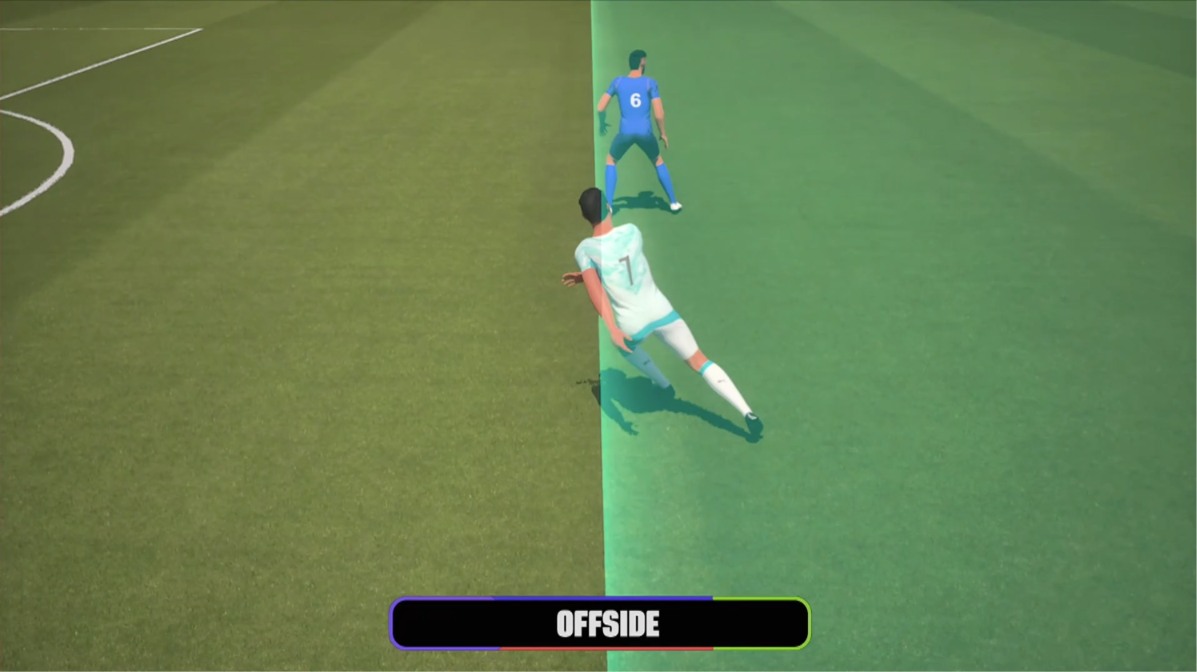
On the television screen, the image — reproduced on the cover of this article — showed two human figures representing Ronaldo’s body, with the number 7 on his back, and that of his marker, Josip Šutalo, in blue.
The part of Ronaldo’s body that appears ahead of the line does not constitute any sporting advantage: a bit of his left shoulder and arm, a little more than half of his head, and less than half of his right arm. Ronaldo is leaning forward, beginning his run to receive the ball, but his feet are clearly behind the line marked by the feet of his defender.
I am Argentine. I have played football all my life, and so did my father. Every time I have a ball at my feet, I feel something I cannot fully explain. Football is a passion for me, and it defines a meaningful part of my identity.
To my eyes, there is no sporting argument that justifies this decision imposed by Espen Eskås, the Norwegian referee in charge of the match - Controversies like this have already occurred at least six times since the beginning of the World Cup.
But since the defining feature of this episode is a sophisticated technology that seems to bring every possible argument to an end, I will try to explain what is happening — without forgetting that football is, at the same time and at a minimum, a game, the world’s most popular mass sport, a global business, and a political matter.
How offside is currently measured
In November 2024, FIFA and Sony announced the creation of a joint venture called Football Technology Centre AG, based in Switzerland. Sony participates through Hawk-Eye Innovations, its sports technology division, for high-performance competition.
FIFA Secretary General Mattias Grafström said at the time that “this joint venture is just another example of the extent to which FIFA is leveraging technology to optimize football operations and play a leading role in technological developments for the benefit of our 211 member associations.” What he omitted is that it becomes striking when an entity as powerful as FIFA — which organizes and regulates an event of the scale of the World Cup — manufactures a product it will later buy.
The technology they worked on is Semi-Automated Offside Technology, or SAOT, which had already been used at Qatar 2022. They added some layers of precision and infrastructure.
In short, Hawk-Eye’s sports tracking technology is presented as a support tool for video assistant referees and on-field officials, designed to make offside decisions “faster, more reproducible and more accurate.” In its base version, it uses tracking cameras installed in the stadium to monitor the ball and up to 29 data points per player, 50 times per second. It also combines those data with ball sensors to detect the precise moment of contact.
For the World Cup currently being played in North America, the system rests on several layers: the official Adidas TRIONDA ball, with connected technology; a motion chip; player-position data; artificial intelligence; and more realistic 3D avatars created through body scans. Adidas says TRIONDA uses an evolution of its Connected Ball Technology, with a side-mounted chip, and that ball data are sent in real time to the VAR system to assist offside decisions.
Lenovo, FIFA’s technology partner for the 2026 World Cup, provides the 3D scans and avatars. FIFA reported that players were digitized to create precise body models, used both in offside animations and in tracking fast or obstructed movements.
Algorithmic governance
Since this type of SAOT was implemented at the 2025 Club World Cup, it has faced criticism. Not only because of the feeling that it distorts football, but also because, if we go a step further, it raises a problem of algorithmic governance.
The Premier League, for example, does not use this technology. It uses another system, called GeniusIQ, developed by Genius Sports.
The use of SAOT was unanimously approved by the English clubs in August 2024. Referees also took part in the implementation process.
The product, certified by FIFA, belongs to Second Spectrum Optical Tracking System — Dragon — supplied by Genius Sports Limited.
It uses around 30 iPhones throughout the stadium, machine intelligence, and the tracking of thousands of points per player to reconstruct the body in 3D.
But it also incorporates something called a “tolerance zone”: a human and sporting criterion embedded in the architecture of the software.
The main purpose of this tolerance zone is to compensate for inaccuracies and inconsistencies. It materializes as a five-centimeter thickness in the virtual wall created by the system when analyzing the positions of players. Translated into football terms, a player is considered offside only when he is at least five centimeters ahead of his marker.

FIFA, however, through its own SAOT system, prefers that VAR alert the main referee that a goal deserves review even when the positional difference is a matter of millimeters, or when it involves body parts that: a) no athlete can fully control; and b) are not relevant to football and therefore do not create an advantage when ahead of the line.
There is no addition of sporting judgment within the system. Instead, the decision is left to humans: whether to call the referee, and whether the referee chooses to review and make the call according to his own criteria. The problem is the pressure of the crowd, the pressure of colleagues who tell him a play must be reviewed, and the truth bias created by what the system reconstructs.
The five centimeters applied in the English tournament do not seem sufficient. But because they are built into the system, at least human beings are not analyzing such a heavily biased diagnosis.
Still, five centimeters of tolerance is clearly not a sufficiently reasonable criterion.
In the disallowed goal during Colombia’s match against Portugal, Davinson Sánchez thought he had secured victory for Colombia in stoppage time when, at the far post, he headed in a cross from Juan Quintero. The goal was canceled for an offside that identified such a small part of Sánchez’s foot that it seemed to cover nothing more than his big toe.
Just as a goal is awarded when the ball fully crosses the area defined by the goal line, it sounds logical to understand offside as a position in which the striker has one full foot ahead of the line of the second-to-last opposing defender at the moment the ball is played by a teammate.
Feet are fundamental in football, and we can control them with reasonable precision.
What we must now understand is how to create governance systems that guarantee we control algorithms.
But we must also consider that behind this technical challenge there is another one — political, cultural, and economic — which requires taking into account the billions of people around the world who find in football a passion that deserves to be respected as a genuine popular expression. Football, however, rests on an entertainment business in which capital interests intervene, and those interests do not necessarily share the values of those who fill the stands.
Football tradition is inseparably tied to the identities of people. With subtle differences, every football lover knows that, before anything else, a ball is enough to enjoy this sport. When it becomes a competition and a business, we try to make sure it does not lose its essence, naïve as that may sound.
Technology runs through every part of our lives, and football will not be the exception.
Always accompanied by optimistic and well-intentioned arguments, we keep incorporating technology into everything. We want to make fewer mistakes, and when it comes to sport, we want to be fairer in a competition we understand as healthy.
But then there are interests far larger than us. If the SAOT system that FIFA developed and bought is facing criticism because, in the end, it imposes a form of sporting technocracy that had already been questioned before this World Cup began, why do they keep using it?
The alternative to Semi-Automated Offside Technology
This year, Canada began testing a different solution called Daylight Offside, or the “Wenger rule,” promoted by Arsène Wenger from his role at FIFA. It does not change the technology involved. It changes the underlying interpretation, recovering the meaning of offside as the rule was originally conceived.
To understand offside in daylight terms means that it no longer matters whether the tip of a boot, a knee, a shoulder, or half a head is slightly ahead. To disallow a goal, there must be visible “daylight” between the defender and the attacker.
The current rule, by contrast, states that a player may be in an offside position if any part of his body that is valid for playing the ball — head, body, or feet — is closer to the opponent’s goal than the second-to-last defender.
That rule dates to 2005. It sought to refine the idea of the player in an offside position in an era before AI.
Once algorithms were applied, the rule should have been reviewed. Although it clarifies that arms are not counted, it makes it possible for a piece of shoulder or head to be considered valid grounds for canceling a play.
In fact, nobody dares to question what is seen — that is, the truthfulness of technology. But it is worth remembering that algorithms make mistakes. None of them offers 100 percent effectiveness. Therefore, it should be the human being who contextualizes the image provided by the video reference system.
Qualifying what that small brain tells us as it recreates a play would be a good first step, because it helps avoid truth bias.
The second step would be to place the analysis within a sporting, popular, and mass context, without ignoring the nature of the rule: offside exists to prevent attackers from gaining an advantage through their position close to the opponent’s goal. Every decision to disallow a goal should pursue that purpose.
The honorability of the game is what the rule sought to protect, by preventing anyone from taking advantage of their position. That is the spirit that must be preserved. Hurting a team and interrupting the game through technological interventions that are imperceptible to human beings makes no sense.
Third, politics and business are much harder to get through. In this case, the dispute over the technology applied to football reveals at least a double role that is usually viewed with suspicion, because it does not sound very transparent for FIFA to approve and implement a technology developed by its own company.
To which other leagues or tournaments will this system be sold? If regional tournaments consider applying other technologies or rules, such as GeniusIQ or the Daylight Offside Rule, will FIFA approve them? Who wins and who loses every time decisions like this are made in football?