On Monday, September 24, 1945, New York awoke to sidewalks packed with office workers crowding the entrances of every building in the financial district.
Around the Empire State Building, along Broadway and across Manhattan, the doors of thousands of towers stood wide open, with piles of mail and newspapers stacked everywhere. Postal workers tried to locate the recipients of their envelopes; elegantly dressed women stepped away from the facades and looked upward, searching for an explanation.
Confusion reigned.
It became one of the most memorable strikes in the city's history. Nearly 15,000 elevator operators and building-maintenance workers, organized by the Building Service Employees International Union, walked out over a reduction in take-home pay as the wartime workweek was shortened to 40 hours.
The chronicles of those days make clear that New York was already a city built upward. Several of its emblematic buildings rose more than 60 stories. For the rest of that workweek and into the following Monday, the financial center of the Western world became horizontal again, producing an estimated loss of $100 million.
The conflict ended on October 1, when workers returned under an agreement to arbitrate the central dispute: whether shortening the workweek to 40 hours would also reduce take-home pay. The arbitrator was to be chosen by New York's governor.
One thing became unmistakably clear after that week of striking: the workers who operated the elevators had exposed an Achilles' heel in a society that depended on them.
In the earliest electric and hydraulic elevators, the passenger entered, named a floor, and the operator:
- closed the landing door and the car's gate;
- moved a lever or controller;
- regulated the direction and, in some models, the speed;
- braked as the car approached its destination;
- leveled the car with the floor;
- opened the doors and managed boarding and exit.
Stopping correctly required experience. If the operator braked too soon or too late, the car had to be moved a few inches until it aligned with the landing.
Technology advanced, and mechanical systems were combined with electrical ones to simplify the operator's task and improve the passenger experience. Gradually, the operator intervened less and less. By the time of the strike, the most important aspects of the operator's presence were expertise and the reassurance of having a skilled worker inside the elevator.
And yet, viewed from 2026, the end of the story is easy to infer: by the 1960s, automatic controls had made passenger-operated elevators increasingly common, and an employee no longer had to accompany every trip.
Contemporary accounts indicate that, at first, not everyone calmly accepted riding in an elevator without an expert operator within reach.
Two developments converged so that, in the decades that followed, elevator operators largely disappeared from ordinary office buildings. On one hand, the function of the buttons and controls installed outside and inside the elevator became increasingly easy to understand, while braking, acceleration and door operation were automated. On the other, new generations came to regard this unstaffed vehicle—operated directly by its passengers—as entirely natural.
By now, I suspect the similarities with another technology that is once again changing everything are beginning to emerge.
The Human Capacity to Adapt: My Waymo Experience
A week ago, I decided to download the Waymo app.
My 74-year-old mother had come from Buenos Aires to visit us in Miami, and my daughter had said several times that she wanted to ride in a driverless car.
My wife and I had discussed it repeatedly. Even while driving our own car through the city, we paid particular attention to those white Jaguars whose steering wheels turn on their own. On the highway, we often agreed that they made us feel somewhat uneasy.
A friend had also told us that Tesla's Autopilot, extraordinary though it is, made him deeply uncertain for a couple of years, until he finally dared to travel more than 50 miles without needing to take over the driving controls.
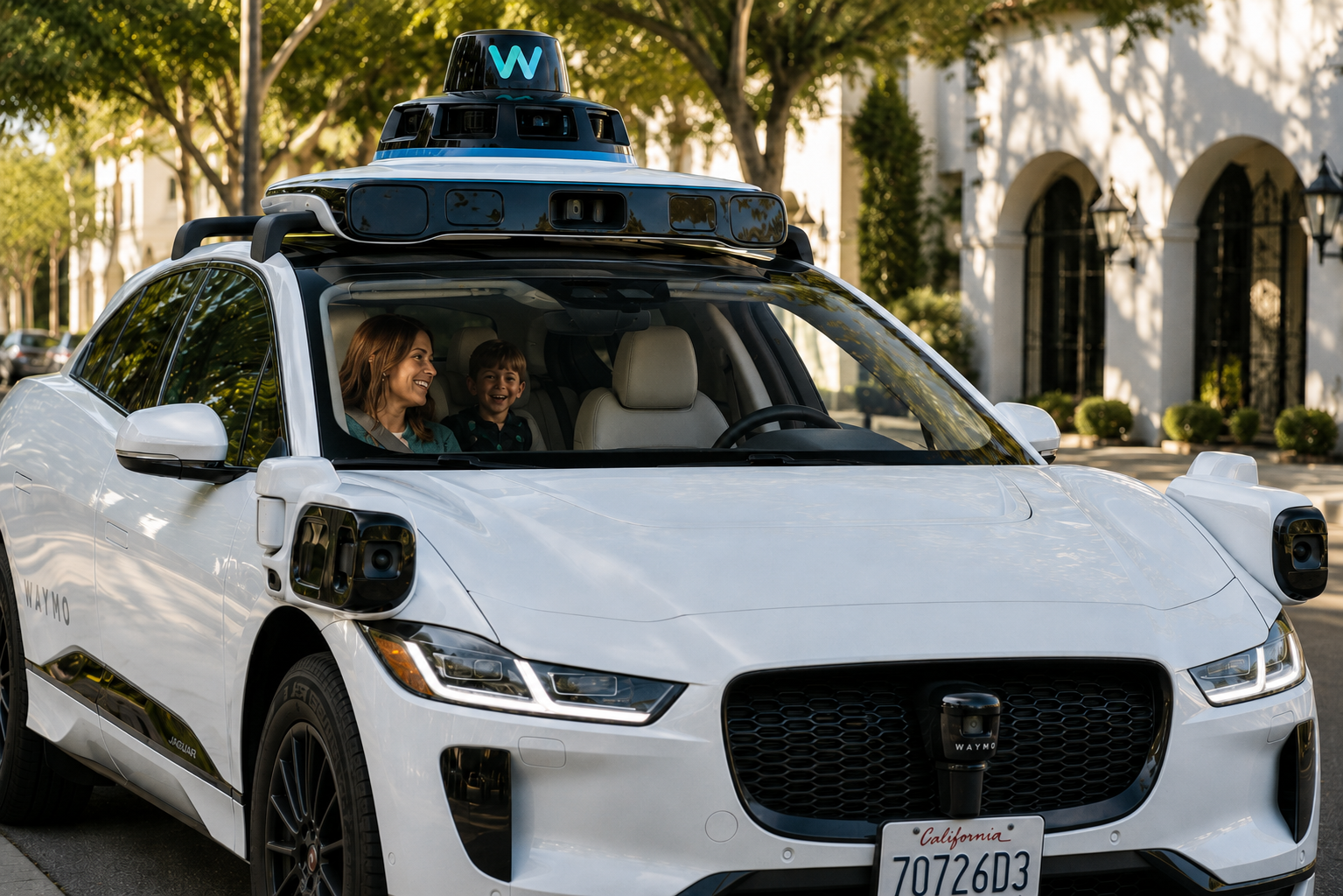
The truth is that the moment the Waymo began approaching me - I watched it cross the street, make a U-turn and climb the ramp opposite the gym I attend in Coral Gables - I was overcome by fascination.
The app had set a precise pickup point, and the car stopped directly in front of me. Bluetooth allows the Jaguar to recognize the passenger's phone nearby. It pulled up with the right rear door waiting for me.
I unlocked it through the app while trying to film. The door handles slid outward; I opened the door and climbed in. It smelled clean. Relaxing music was playing.
We had traveled less than two blocks when I realized that none of the fears I had imagined before getting in - the ones I assumed I would feel inside a driverless car - had appeared. I was exhilarated, trying to narrate the experience while taking everything in.
As I had instructed through the app, we went home to pick up my wife, my mother and my daughter, whom I surprised with this new kind of ride-hailing vehicle.
With them inside the car, I confirmed something that allowed me to see the parallel with the elevator: suddenly, traveling from one point in the city to another felt genuinely intimate, even though we were not using our own car. We were a family enjoying the ride with no stranger among us, speaking to customer-support voices when we needed them, while every outside human presence appeared and disappeared at our discretion.
Then I remembered what it feels like to share an elevator.
It is an unresolved debate, something that pulls at us. Those who use elevators every day will admit - I did so for more than ten years - that most of the time they would rather ride alone.
That desire for solitude is frustrated whenever another passenger steps in: awkward conversations follow, eyes turn downward, and bodies stand too close among people who do not even intend to greet one another.
But when the elevator operator was part of the mechanism, complete privacy was impossible. We knew - and I experienced this myself in old hotels and buildings in Buenos Aires - that at least one other person would always be inside the car with us.
This is exactly what we are beginning to experience now with autonomous ride-hailing vehicles. After a single Waymo trip, I understood that whenever a driver is present, part of my attention is necessarily devoted to that person: they can hear me; I notice their perfume or body odors; they listen to music I may not like; they speak with others, or try to start a conversation with me.
Described this way, it is unsettling to hear oneself, because it means admitting that technology - or the human beings who develop it - exploits those small openings of selfishness that reveal themselves as we move toward total automation.
Why are we like this? I have no answer.
But it is clear that we keep creating layers of technological mediation - devices, software and symbolic entities that interpret everything for us, produce representations and, today, converse with us autonomously - that distance us from one another.
At times, that tendency isolates us or makes life more difficult, and then we demand the presence of a human being. Customer service is the clearest example.
A Pew survey conducted in February 2026 found that only 5% of American adults had ever ridden in a driverless vehicle. Seventy-one percent said they would feel not too comfortable or not at all comfortable doing so; just 7% described themselves as very or extremely comfortable. But among those who had already taken a ride, 40% said they felt very or extremely comfortable.
The impact of experience on our cognitive apparatus appears to be fundamental, because these figures match what I lived and described above. In technology, what looks risky and unsafe before it is experienced can rapidly become part of everyday life.
At the same time, as human beings and our abilities are replaced by interfaces, the points at which people can exert pressure on increasingly technological systems become fewer.
Indeed, in the analysis Uber vs. Waymo: Power and the Battle for the Network, I explained how Uber is now trying to preserve its monopoly over data through arguments that resist technological innovation - the exact opposite of what happened ten years ago, when taxi drivers tried to stop the urban-ride giant from entering cities around the world.
Taxi drivers were genuinely autonomous. Uber made drivers who provided urban transportation dependent on an app-platform that concentrates every operation. Now, if Waymo wins the battle to use its own app throughout the United States, it will displace Uber by putting driverless vehicles on the road.
In any case, the trend toward traveling in driverless vehicles appears irreversible.
Beyond Waymo, Tesla already operates a robotaxi service in limited areas of Miami, Austin, Dallas and Houston. Zoox, owned by Amazon, represents the most radical conceptual leap: a cabin with four facing seats, no trace of a driver's position and a design resembling a subway car, moving beyond the visual grammar of the automobile. It is available to passengers in Las Vegas and San Francisco and is preparing deployments in Austin and Miami.