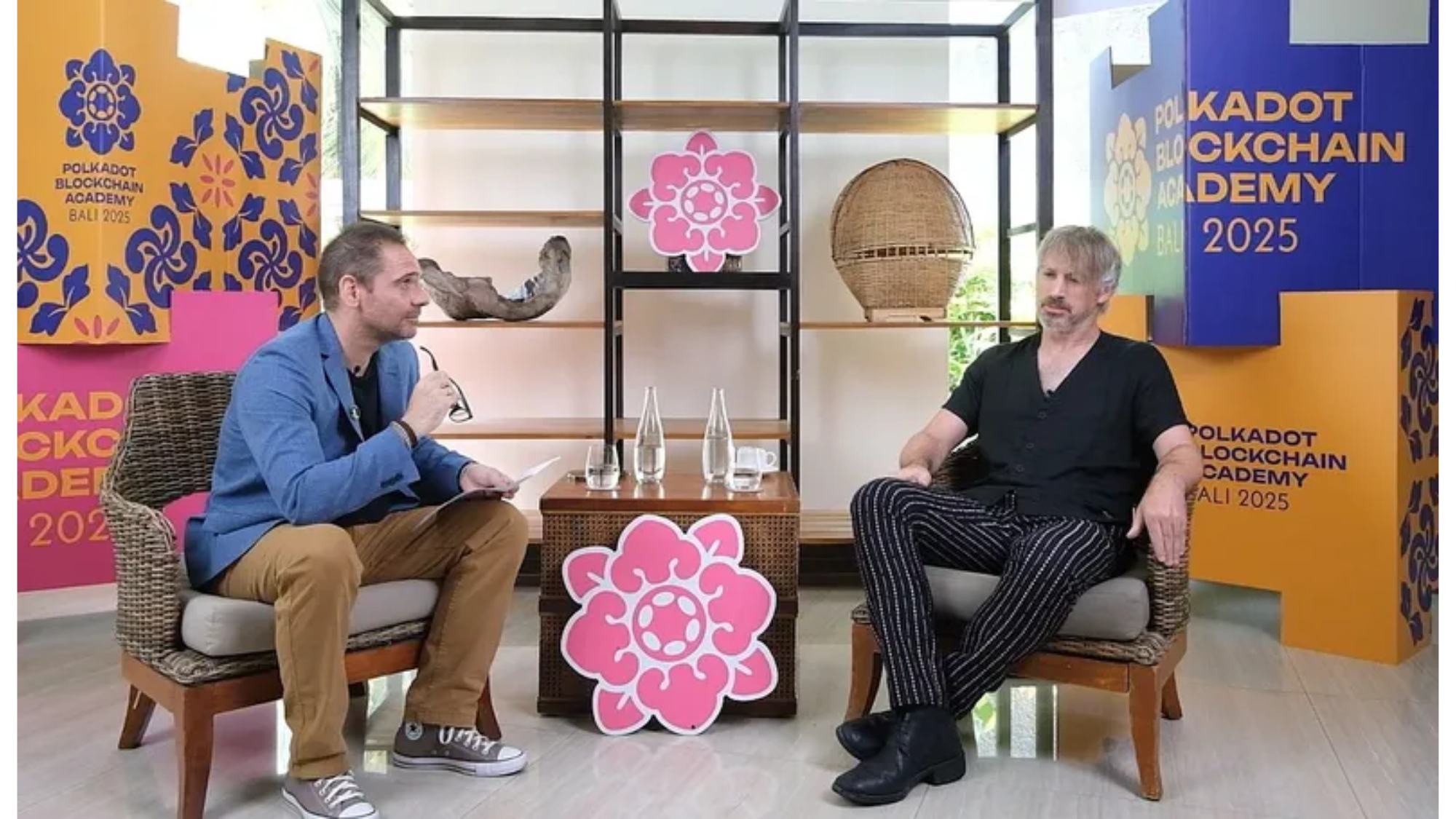
You have led some of the most significant technological developments of recent years, and you are now working on JAM, the Join-Accumulate Machine. Could it be described as a kind of universal computer? What is JAM, and why does it matter?
JAM is an important technical upgrade to Polkadot. At its core, it will give the network much greater potential and allow applications to be used by many more people around the world.
But something else is almost as important as the technical upgrade itself: we want this technology to be understood by far more people than the original Polkadot technology was.
One of the great difficulties in this field is achieving the widespread dissemination of expertise. That is partly why we have the Polkadot Blockchain Academy: to help spread that knowledge. Only by disseminating expertise can we reasonably expect this technology to become a widely used, web-like protocol.
With JAM, unlike with the first version of Polkadot, we are trying to incentivize independent developers, students, small teams and perhaps one or two larger teams to read the technical description I wrote and bring it to life in software.
That requires a great deal of understanding. It is not a particularly easy document to read. This is why we created a substantial prize fund: to help people overcome the intimidating initial stage and support the work required to turn the specification into functioning code.
According to estimates published by specialized media, only between 300 million and 500 million people worldwide use blockchain technology in any form. That is still a clear minority. If blockchain continues to be perceived primarily as a platform for cryptocurrency trading, can we expect the kind of mass adoption the industry has been anticipating?
That is absolutely true. Since returning as CEO of Parity, a company I founded ten years ago, I have been focusing on products that are not intended only for those 300 million to 500 million people, but for the other eight billion people in the world.
The potential of blockchain is widely discussed within the industry, but it remains difficult for the broader public to understand. At the same time, we are witnessing a growing lack of trust in democratic systems. With the exception of those at the ideological extremes, many citizens seem increasingly disconnected from politicians and institutions.
Do you believe technologies such as DAOs could offer meaningful solutions in this context? I am thinking particularly about your ideas concerning rational behavior, trust and truth.
Absolutely. That is one of the reasons I am still here.
There are several reasons. One is the desire to build products that genuinely make a difference to my own lifestyle and, hopefully, to the lives of many other people. But another is my belief that this way of building and architecting products is something the world needs.
The products we are discussing would have been an alien concept when I was born, in 1980. We do not think about this very much today, but modern products are themselves products of our connection to society.
They usually have an application or a website, and most of the time we do not think too deeply about the people behind them, unless those people are placed front and center. In reality, however, most modern products depend on many other people using the same system and facilitating those interactions.
Consider a bank. I might think of a bank simply as a way of sending and receiving money, or perhaps exchanging one currency for another before going on holiday. But a bank is really a network of people and companies. I can make those transfers and exchanges only because there are other people at the opposite end, with the bank acting as an intermediary between us.
The same is true of almost every modern product. There are a few sectors where this dependency is less evident. Cars might once have been an example. But even cars are now frequently supported by social networks and collective systems.
Consider Tesla. Much of its more recent technology is built around artificial intelligence, which itself depends on people feeding information into its systems.
Once we understand that our modern, product-centered lifestyle depends on a wider social network, we must also accept something philosophers explained hundreds of years ago: there is a form of contract between the individual and society.
In reality, it is an enormous patchwork of contracts, many of them completely opaque.
Suppose you buy a Tesla. You will probably receive a license agreement. It may be 50 pages long, or perhaps 100 or 200 pages. It will consist of dense legal language whose implications even a legal scholar might not be able to predict with certainty if the agreement were challenged in court.
And yet you are expected to accept it before you can use your car.
Is that reasonable? Is it reasonable to expect people to do this? Of course not. But this is the society in which we live: a society built upon a patchwork of opaque social contracts, in which those who demand complete clarity are effectively expected to become recluses or exiles.
Even if people would not identify this as the specific problem they see in society, I suspect it contributes significantly to their sense of disillusionment and disconnection.
The technologies I have been developing, and hope to continue developing, are intended to make a difference here: to introduce clarity, reduce the number of rules to which we must submit in order to avoid exclusion and, as every product should, bring a certain degree of joy into people’s lives.
Your work frequently focuses on reducing rules and removing intermediaries. This is especially relevant when we think about centralized information, Web2 and the institutions that organize the world as we know it.
But eliminating the intermediary is extremely difficult when that intermediary is a government, a corporation or another powerful institution. It is also difficult to persuade people that they can conduct transactions or work together without trusting a traditional central authority, simply because the technology makes that possible.
How can this transition actually occur?
You are absolutely right. It is not easy to dislodge incumbents, at least not in calm waters.
But we are not in calm waters. We are in difficult waters, in quite choppy seas. People are paying attention. Their eyes are open, and they are willing to try new things when those things can be credibly shown to improve their circumstances.
Buckminster Fuller once said—and I am paraphrasing—that it is foolish to try to change a system by fighting its incumbents. It is far more sensible to create a new paradigm and allow the old one to continue along its path toward irrelevance.
That is essentially what we are doing.
There is no desire here to fight the existing system directly. We are creating new ways of doing things. If we do this properly, I believe those alternatives will be discovered, become widely known and eventually be used. The old ways of doing things will simply cease to be relevant.
The United States recently approved the GENIUS Act, establishing a federal regulatory framework for stablecoins. How do you understand the role of stablecoins today, particularly in comparison with non-stable cryptocurrencies? And what is your view of government-led regulation in this area?
I think there are parts of government that mean well. There are parts that are somewhat ignorant. And there are certainly governments, or parts of governments, that do not necessarily mean well for society as a whole, even if they act in the interests of themselves or their families.
Stablecoins are an interesting question.
I see stablecoins as an off-ramp from the present system. They occupy a middle ground between a traditional financial instrument—the US dollar, the euro or another national currency—and something new.
The US dollar is the currency most frequently used as the reference asset for stablecoins. On one side, therefore, we have a traditional financial instrument. On the other, we have something capable, at least in some circumstances, of being transferred trustlessly and autonomously across the internet.
Those terms may be overly generous when applied to certain stablecoins, but the result can still involve less friction and greater freedom for the individual holding them.
Even that claim is debatable when you compare a stablecoin with a physical twenty-dollar bill. A twenty-dollar bill cannot be remotely blocked. A stablecoin can.
We must remember that when politicians talk about stablecoins, what they usually mean is a bank account. It is a bank account in which transactions are authorized through a cryptographic key rather than through a passport or a handwritten signature.
That is fine. I have no objection to bank accounts. I have bank accounts myself. I am not going to embark on a crusade against them.
But we must remember that one of the central sources of value in cryptocurrency—and in Web3 technologies more generally—is that it returns agency to the individual. It moves power away from the bank and gives some of it back to the user.
When we use something such as USDT or USDC, we are, in effect, returning that power to the bank or the issuing institution.
Bitcoin returns that power to the individual. With USDC and USDT, the institution behind the asset retains the ability to block or expropriate someone’s holdings. Many people may not be aware of that.
I was not aware of it.
But it is true.
If we compare that model with an algorithmic stablecoin based on a genuine cryptocurrency—one whose value does not depend upon a bank offering redemption—we have a different proposition.
Consider something such as DAI. It is an algorithmic stablecoin. It cannot be expropriated by a bank in the same way. That is the difference.
Someone might say: “I am an American citizen. I have rights. I do not believe the bank is going to act against me. I am perfectly comfortable using USDC. It is simply a better bank account.”
That is a perfectly valid opinion. There is nothing factually wrong with it. But does it create a better world?
Not necessarily. One of the things that distinguishes your perspective is that you are constantly looking at the larger picture.
We are speaking in Bali during the Polkadot Blockchain Academy, where technologists and policymakers from 39 countries are learning how blockchain works and how it can be applied. We are also observing Indonesia’s emergence as a regional example of digitization.
From a global perspective, but thinking particularly about developing regions such as Latin America, what challenges do you see in the relationship between governments and technology?
In my experience, governments generally exist to preserve the status quo. Their purpose is to keep people happy.
In a democracy, if you have been elected and people are happy, you will probably be reelected. In another type of political system, if your family is in power and people remain happy, you may be able to pass leadership on to your children.
Broadly speaking, the emphasis is on keeping people satisfied and maintaining the status quo.
There is also a great deal of money moving through governments. Why? Because governments collect money from society and then spend it. The amounts involved are inevitably very large. Even rounding errors become enormous.
When so much money is moving through a system, resources begin to slosh around. If people remain reasonably happy, they do not pay too much attention to those rounding errors.
Unfortunately, this tends to produce a particular mindset—one that is essentially technophobic.
Technology means change. Change means risk. And the risk is that people will no longer be happy.
Broadly speaking, people in power do not want to take risks. They may have taken a risk when they ran for office, but once they are in power, they generally want to keep the ship sailing in a straight line.
That creates a problem.
Sometimes political leaders rely on technocratic bureaucracies to help run the country and maintain its operations. Those bureaucracies may advise them to adopt one technology or another. But established bureaucracies are not usually inclined to take risks either.
They tend to turn to the same technology providers that supplied governments 30 years ago. Those providers, if you will forgive the stereotype, are often led by older men who do not really understand new technologies or new ways of thinking.
That is unfortunate. I briefly worked in military technology, and I met people of this kind. They were nice people, but they were not going to make a major difference to society—or at least not the kind of difference that would be genuinely felt by individuals.
I will give you a simple example.
When Google introduced its suite of products—Gmail, Calendar and the other tools—nearly 20 years ago, I remember thinking that it would be extraordinary if people with that kind of product-oriented mindset were able to develop national software systems.
Imagine applying that approach to tax payments, driving licenses, passports, voting and all the other things a country provides to its citizens or expects its citizens to do.
It could produce a far better experience of citizenship, or at least an experience far better than the one most people currently have.
Why did governments not hire those people?
Because Google was new. It had not been delivering technology to governments for 30 years. Decision-makers in their fifties and sixties did not know Google’s decision-makers. There was a disconnect.
We will probably see a similar disconnect between today’s decision-makers and the Web3 technologies we are building.
In some sense, it is my job to build those bridges—to help decision-makers cross that gap and understand the technology.
There may be some risk, but this technology has been extensively tested in public. Billions of dollars have been at stake, and no attack has successfully sustained itself against these systems. I therefore do not consider the risk to be particularly substantial.
Nevertheless, every new technology involves some degree of risk. My job, I suppose, is to convince governments that the risk is justified by the potential benefits for society, citizens and businesses.
That is the real challenge.
I do not see government and technology as fundamentally incompatible. Not at all. I have seen good technology deployed by reasonably competent governments.
Singapore is one example. A few years ago, I spoke with the minister responsible for new technologies or digital infrastructure. He was well informed, understood product development and was working with the appropriate technologies.
It is therefore not impossible.
The difficulty is persuading people that the cost and risk of adopting a technology are justified by the benefits it can produce. A large part of that process, in my view, is education.
That brings us back to the Polkadot Blockchain Academy: helping decision-makers understand why one technology, or one way of developing technology, may be better than another.
I hope this interview can contribute to that purpose. It has been an honor speaking with you. Thank you very much for your time.
Thank you. It was lovely speaking with you.